main partner

23—26.04.26 Brussels Expo
main partner
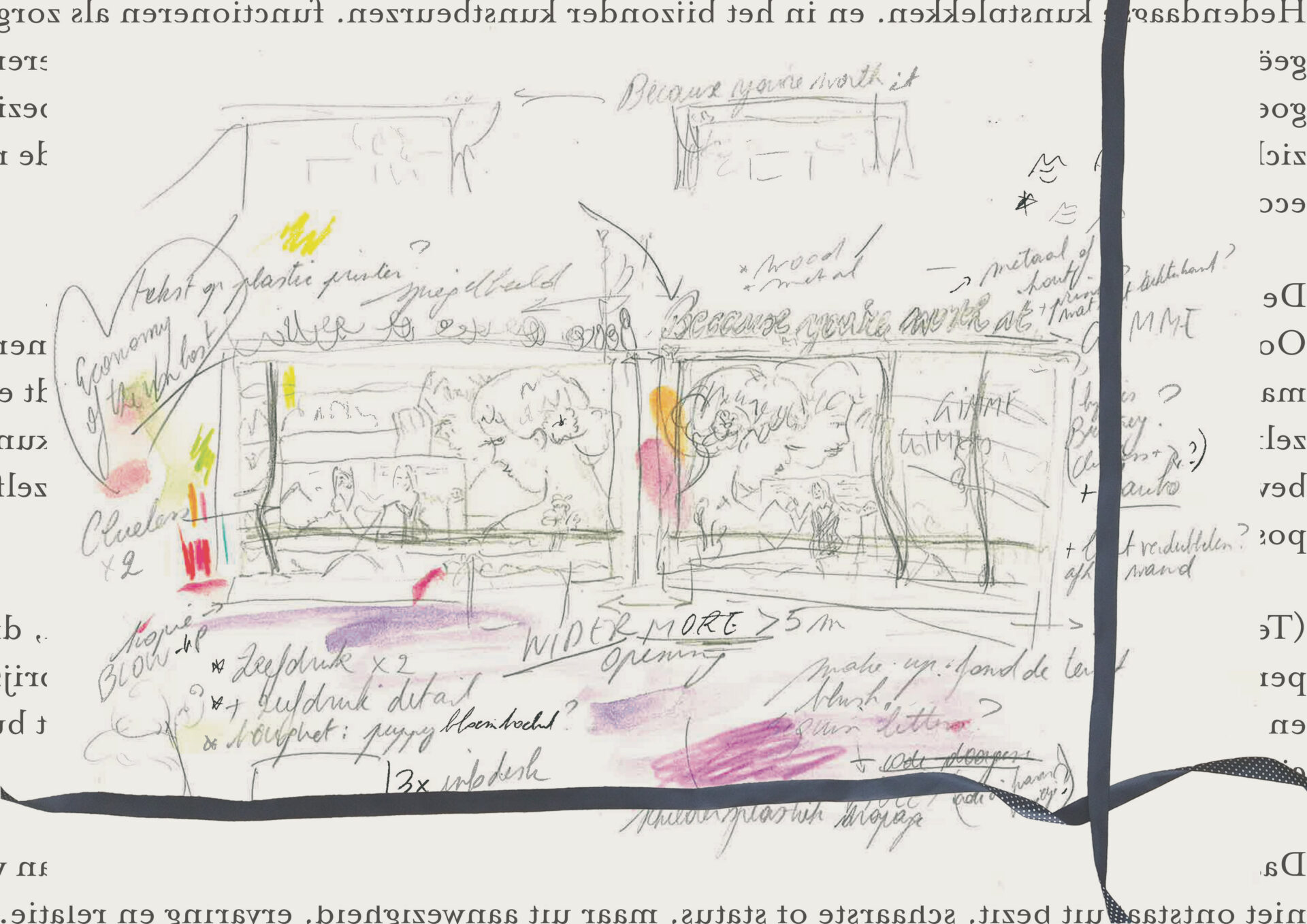
Sketch by Natasja Mabesoone, 2026
Art Brussels 2026 opens with a major new commission by Belgian artist Natasja Mabesoone, represented by Gallery Sofie Van de Velde (Antwerp). Invited to create a site-specific installation at the entrance of the fair, Mabesoone will transform the arrival experience into a compelling artistic statement, setting the conceptual and curatorial tone for this renewed and ambitiously curated edition.
The wallpaper for the installation will be produced and kindly supported by Masureel
Natasja Mabesoone (°1988, BE) works at the porous edges of printmaking, drawing, and painting, where conceptual reflection, material engagement, and social context exist in constant dialogue. Her practice departs from the understanding that the printing press is never neutral: it registers touch, pressure, residue, and loss, producing images through repetition and degradation. Each impression carries traces of what transfers and what resists, foregrounding contingency, chance, and failure as productive forces within an image economy shaped by consumption, saturation, and power. Language and image intersect in Mabesoone’s work as sites of politics and social construction. Through a feminist lens, she unpacks myth and pop culture, examining how meaning is produced, circulated, and deconstructed.
Her practice activates visual languages often coded as feminine—glitter, makeup, scratch lettering, stencils, and temporary tattoos— alongside etching, monotype, silkscreen, collage, drawn scribbles, and painterly gestures. These elements are never mere ornament. The cute and decorative operate as subtle, oblique forms of resistance, gently destabilizing hierarchies of value, authorship, and visibility. Mabesoone’s work attends to the slippages between seeing and touching, knowing and feeling, proposing vulnerability, play, and attentiveness as critical strategies for navigating contemporary visual culture.
Processes of gossip, repetition, translation, and mis- or re-reading shape her exhibitions, where works mutate and rearticulate earlier gestures. Installations, works on paper, murals, and site-specific interventions respond to their surroundings and to one another, generating spaces in which instability, contamination, and pleasure become critical vectors.