main partner

23—26.04.26 Brussels Expo
main partner
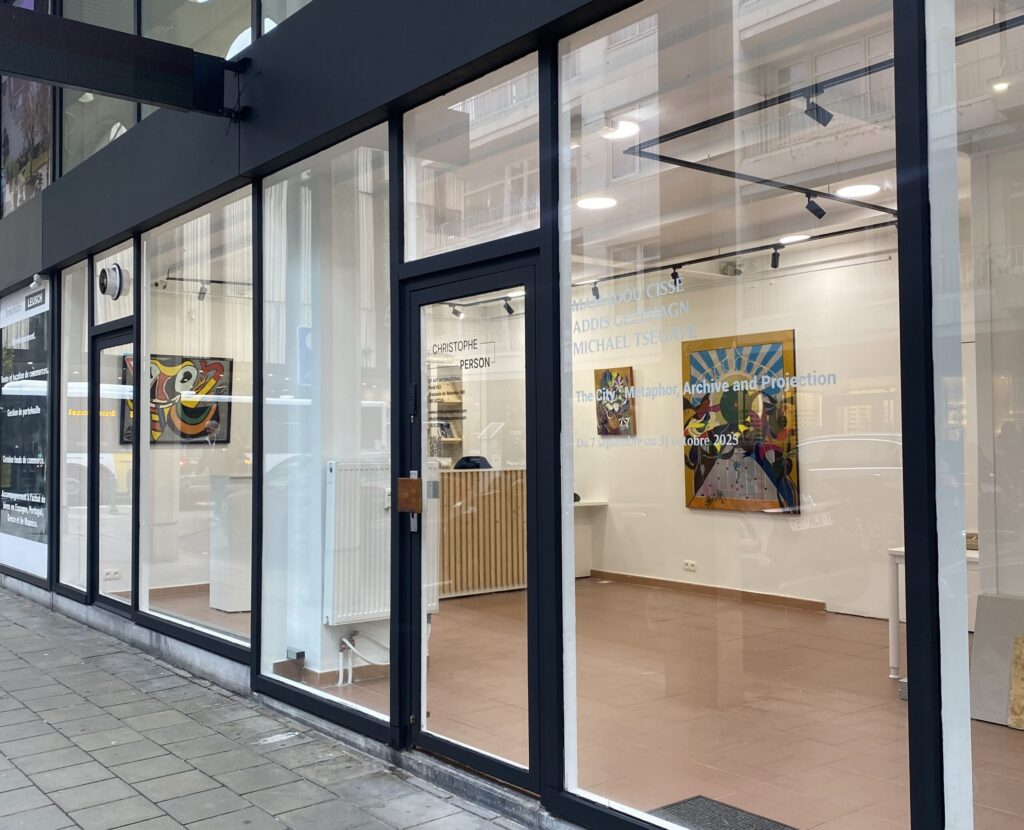
Artists shown at the fair:
Section: prime
Gallery location: Paris, Bruxelles
Saturday 25 April
3 – 3:50 PM at the Tribune
(This conference will be given in French – see the explanatory text in French below)
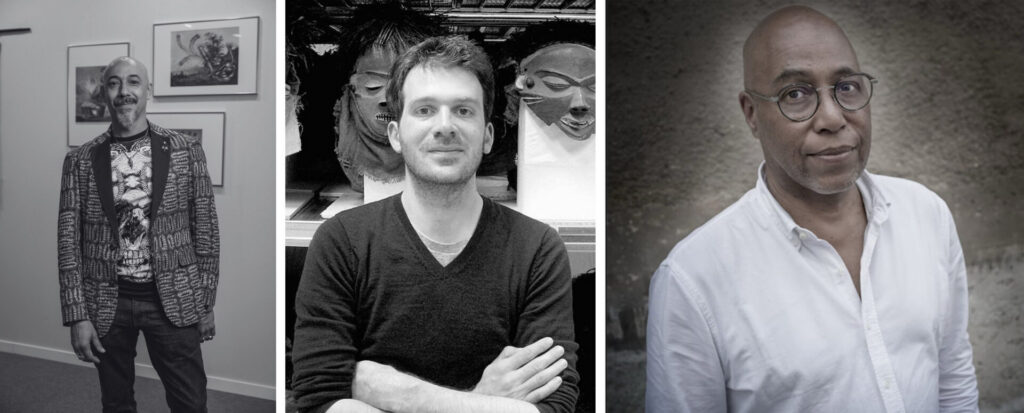
Artist talk with Thiémoko Claude Diarra (artist, Christophe Person), Julien Volper (historian, Royal Museum for Central Africa in Tervuren) & Sitor Senghor (artistic director of AKAA – Also Known as Africa).
Animism is a living force that runs through African cultures – a link between the visible and invisible worlds, between ancestral heritage and the present. Contemporary artists transform it into a dynamic force in motion.
In Thiémoko Claude Diarra’s work, earth is not a material: it is a presence. His pigments carry a memory of the soil, a connection to a territory. Working with the material means entering into a relationship with it. The pigments he collects, prepares, and applies are not chosen only for their color, they are chosen for what they carry: a memory of the soil, a symbolic charge, a deep connection to a territory. When he works with bogolan, a Malian fabric dyed with mud and plant extracts, he does not simply reproduce a traditional technique. He initiates a dialogue between the material and the invisible, between the artistic gesture and the forces that traverse the world.
An approach that resonates with urgency: what does animism tell us about our relationship to the living, in this time of ecological crisis?
About the Speakers:
Thiémoko Claude Diarra
Thiémoko Claude Diarra situates his work within a contemporary exploration of animism, where forms, materials, and symbols engage in a dialogue with ancestral spirits and myths. Through an approach that blends abstraction and figuration, he creates works imbued with invisible forces, in which the act of painting becomes a ritual for reactivating the sacred. His work revolves around the use of earth pigments, which allow him to establish a connection with the ancestral practices of African animism, particularly the Bogolan in Africa. These natural earths become the mediums of a transmission, where the raw material engages with the invisible forces of the sacred.
Julien Volper
A French national, Julien Volper holds a Ph.D. in art history from the University of Paris I Panthéon-Sorbonne. He works as a historian in charge of ethnographic collections at the Royal Museum for Central Africa (Tervuren, Belgium). He was a lecturer in African art history at the Université Libre de Bruxelles (2017–2023). A member of the editorial board of the journal Afrique: Archéologie & Arts and a CITES expert, he has also curated several exhibitions. He is the author of some sixty articles and books focusing in particular on the history, art, and religions of the Congo. At the Thomas More Institute, which he joined in September 2020, Julien Volper works on issues related to cultural policies, memory policies, and the political, museum-related, cultural, and moral challenges posed by the restitution of artworks and artifacts.
Sédar Senghor
Initially working as an investment banker and a longtime collector Sédar Senghor has always been passionate about art, he later became an advisor and independent curator. He notably directed the Parisian gallery Orbis Pictus until 2024. Specializing in contemporary African art, he works to promote it internationally at fairs in cities such as Paris, London, Abidjan, and Marrakech. He has helped develop the careers of several African artists, including Nu Barreto, Aliou Diack, Ernest Dükü, and Ouattara Watts.Since 2020, he has worked on more than twenty exhibitions. In 2022, he notably curated the exhibition “Antoni Clavé, the Spirit of the Warrior” at the Palazzo Franchetti during the Venice Biennale. More recently, in 2024, he was the artistic director of the exhibition “Lee Miller, Saint-Malo Besieged, August 1944,” organized at the Sainte-Victoire Chapel in Saint-Malo during the commemoration of the 80th anniversary of the city’s liberation. A prominent figure in the African art scene, he has been appointed artistic director of AKAA – Also Known as Africa, a contemporary art and design fair focused on AfricaInitially.
FR
La place de l’animisme dans la création contemporain africaine – le matériau comme identité.
Rencontre avec Thiémoko Claude Diarra (artiste, Christophe Person), Julien Volper (historien, Musée royal de l’Afrique centrale à Tervuren) et Sitor Senghor (directeur artistique d’AKAA – Also Known as Africa)
L’animisme est un souffle vivant qui traverse les cultures africaines, un lien entre le monde visible et l’invisible, entre héritage ancestral et présent. Les artistes contemporains en font une dynamique en mouvement.
Dans le travail de Thiémoko Claude Diarra, la terre n’est pas un matériau : c’est une présence. Ses pigments portent une mémoire du sol, une relation à un territoire. Travailler la matière, c’est entrer en relation avec elle. Les pigments qu’il collecte, prépare et applique ne sont pas choisis simplement pour leur couleur, ils sont choisis pour ce qu’ils portent : une mémoire du sol, une charge symbolique, une relation profonde à un territoire. Quand il travaille le bogolan, tissu malien teint à partir de boues et d’extraits végétaux, il ne reproduit pas une technique traditionnelle. Il engage un dialogue entre la matière et l’invisible, entre le geste artistique et les forces qui traversent le monde.
Une démarche qui résonne avec urgence : que nous dit l’animisme sur notre rapport au vivant, à l’heure de la crise écologique ?